
PRODUCTS

TURBOCHARGER
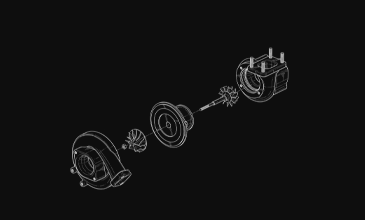
The history of the turbocharger dates almost as back as the internal combustion engines. In 1885 and 1896, Gottlieb Daimler and Rudolf Diesel examined the compression of the intake air in order to increase the engine power and reduce the fuel consumption. In 1925, Swiss engineer Alfred Büchi became the first person to produce a turbo unit which uses the exhaust gas, thus achieving a 40% increase in power. This has led the turbocharger to officially become a part of the automotive industry. Turbocharger is a type of pump which allows increasing the power output of the engine with a smaller volume, by forced filling air above the atmospheric pressure to the engine, and which is powered by the pressure of the exhaust gas. It has two propellers called the turbine and the compressor. The turbine is located on the exhaust side, and the compressor is on the intake side. Rotating with the exhaust pressure of the exhaust gas, the turbine rotates the compressor through a connecting shaft in-between. Thus, a significantly increased air intake is provided to the engine cylinder.
Turbocharger Working Principle
The burnt air-fuel mixture in the combustion chamber transforms into the exhaust gas and it is pushed through the exhaust valves towards the exhaust manifold. At this stage, the pressure of the gas moving to the exhaust rotates the propeller of the turbo on its path. Thanks to this propeller which has multi directional blades, a significant portion of the gas enters the turbine. Once the turbine is filled with pressurized gas, the compressor on the opposite direction starts to rotate as well. This rotating propeller creates a reverse pressure in the air intake part of the compressor housing and generates a suction. As a result of that, the compressed air filled into the housing is pushed from the exhaust part of the housing towards the intake manifold. This allows the compressed air entering the combustion chamber to cause a much more violent explosion when it is ignited together with the fuel.
Lubrication of Universal Joints
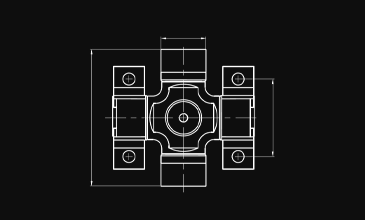
One of the most important factors for a joint is lubrication. They have to be lubricated regularly in order to use them for a long period of time. Using a grease pump, joints can be lubricated through their grease fitting. The grease supplied from this fitting reaches the holes in the trunnion and allows the lubrication of the bearings. Thus, the most sound and ideal joint movements are achieved. It is possible to purge the seals of the joint and they should be purged while lubricating. For extensive periods of use, high quality joints should be preferred. Therefore, you should prefer working with successful and reliable companies in their field when you are purchasing universal joint kits. This would help the vehicle to move as a whole and as rigid as possible.
Technical Details